




How to Stop Hair Fall Naturally? When Should You See a Dermatologist?
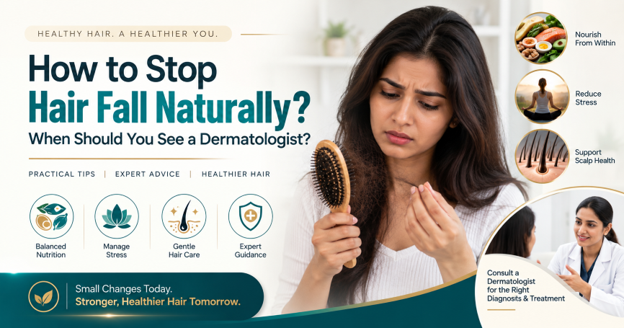
Seeing more hair than usual on your pillow, comb, or shower drain can be worrying. It is natural to wonder, "How can I stop hair fall?" and whether a home remedy can solve the problem.
Some hair shedding is normal because hair naturally goes through cycles of growth, rest, and shedding. The concern begins when you notice persistent shedding, visible thinning, a widening hair part, a receding hairline, or bald patches.
A healthy diet and gentle hair care can support your scalp and hair, but they cannot correct every cause of hair loss. The right solution starts with understanding why your hair is falling. If you are looking for professional guidance on hair fall treatment in Hyderabad , a dermatologist can help identify the underlying cause.
Natural hair care is most useful when viewed as supportive care rather than a cure for hair loss.
Dermatology Expert
Quick Answer: How Can You Reduce Hair Fall Naturally?
For mild shedding, focus on the basics:
- Eat a balanced diet with enough protein.
- Include a variety of fruits, vegetables, whole grains, and nutrient-rich foods.
- Get adequate sleep and manage prolonged stress.
- Avoid very tight hairstyles and excessive heat styling.
- Reduce unnecessary chemical treatments.
- Handle wet hair gently.
- Keep the scalp clean and address persistent dandruff or irritation.
These habits support healthy hair but are not a guaranteed treatment for genetic, hormonal, inflammatory, or medically related hair loss.
If shedding continues or you can see changes in hair density, a dermatologist can help identify the underlying cause.
What Causes Excessive Hair Fall?
Hair loss can happen for several reasons, and sometimes more than one factor is involved.
Stress, Illness, or Sudden Lifestyle Changes
A period of intense stress, fever, major illness, surgery, rapid weight loss, or significant lifestyle change can disturb the normal hair-growth cycle. Increased shedding may appear weeks or months after the trigger.
Poor Nutrition
Hair follicles need adequate nutrients to produce healthy hair. Insufficient protein or certain nutritional deficiencies can contribute to shedding.
However, taking supplements without knowing whether you actually have a deficiency is not always helpful. If a deficiency is suspected, medical assessment can determine what needs to be addressed.
Hormonal Changes
Changes involving thyroid function, pregnancy, menopause, or other hormonal conditions may affect hair growth.
Women experiencing persistent thinning, particularly with other hormonal symptoms, should consider professional evaluation rather than relying only on hair products.
Genetic Hair Loss
Pattern hair loss is a common cause of gradual thinning.
In men, it may appear as a receding hairline or thinning at the crown. Women often notice a wider central part or reduced overall density.
Because this type of hair loss can progress gradually, early assessment may help with long-term management.
Scalp Conditions
Dandruff, inflammation, infection, or other scalp disorders can cause itching, scaling, irritation, and increased shedding.
Treating the scalp problem may be an important part of improving hair health.
Hair Damage and Breakage
Frequent straightening, curling, bleaching, colouring, tight hairstyles, and rough brushing can weaken the hair shaft.
This may cause breakage that looks like hair loss. A dermatologist can help distinguish between hair shedding from the follicle and breakage of the hair shaft.
Natural Ways to Support Healthier Hair
Natural hair care is most useful when viewed as supportive care rather than a cure.
Choose a Balanced Diet
Hair needs protein and a range of nutrients for normal growth. Include suitable sources such as eggs, fish, dairy products, pulses, legumes, nuts, and seeds along with vegetables and fruits.
Avoid extreme diets or rapid weight-loss programmes, which can sometimes trigger increased shedding.
Prioritise Sleep and Stress Management
Poor sleep and prolonged stress can affect overall health and may contribute to temporary hair shedding in some people.
Regular exercise, relaxation practices, adequate sleep, and a consistent daily routine can be useful parts of a healthy lifestyle.
Protect Your Hair From Unnecessary Damage
Simple changes can make a difference:
- Avoid excessively hot styling tools.
- Do not repeatedly pull or tightly tie the hair.
- Limit unnecessary chemical treatments.
- Use a suitable shampoo and conditioner for your scalp and hair type.
- Avoid aggressive brushing or combing.
Take Care of Your Scalp
A healthy scalp is an important foundation for healthy hair. Persistent itching, redness, flakes, or irritation should not be ignored.
Instead of repeatedly changing oils, shampoos, or home remedies, identify the scalp condition and treat it appropriately.
Does Oiling Stop Hair Fall?
Hair oiling can make some hair types feel softer and may reduce dryness, but it does not address every cause of hair loss.
For example, oil cannot correct genetic pattern hair loss, a nutritional deficiency, hormonal problems, or an inflammatory scalp condition.
If thinning continues despite regular oiling, it is worth finding the underlying cause.
When Should You See a Dermatologist?
Not every episode of hair shedding requires medical treatment. However, professional advice is worthwhile when you notice:
- Sudden or unusually heavy shedding
- Hair loss lasting for several months
- Noticeable reduction in hair density
- A widening hair part
- Receding hairline
- Bald patches
- Persistent dandruff or scalp irritation
- Hair loss after a major illness or rapid weight loss
- Loss of eyebrow or body hair along with scalp hair
A consultation is especially important when the hair loss is progressing rather than improving.
How Does a Dermatologist Find the Cause?
A good hair-loss consultation begins with diagnosis, not automatically with a procedure.
The dermatologist may look at the pattern of thinning, examine the scalp, ask about family history, diet, recent illness, stress, medications, lifestyle, and hair-care practices.
Depending on the findings, relevant investigations may also be recommended.
This matters because temporary shedding, pattern hair loss, scalp disease, and nutritional problems require different approaches.
What Treatments May Help Hair Loss?
Once the cause is understood, treatment can be selected accordingly.
Depending on the diagnosis, management may include lifestyle and nutritional correction, medical treatment, scalp care, or regenerative procedures.
PRP Hair Treatment
Platelet-rich plasma (PRP) uses a preparation made from the patient's own blood and introduces it into selected areas of the scalp.
It may be considered for suitable patients with certain forms of thinning or early hair loss. The expected response varies between individuals.
GFC Hair Treatment
Growth Factor Concentrate (GFC) is another treatment option offered for selected hair-loss concerns. It uses growth-factor-rich components prepared from the patient's own blood and applies them to targeted scalp areas.
Whether PRP, GFC, medical treatment, or another approach is appropriate depends on the diagnosis and individual condition.
More treatment does not necessarily mean better treatment. The priority should be choosing the right option for the actual cause of hair loss.
How L'Avenir Approaches Hair and Scalp Concerns
At L'Avenir Skin & Hair Clinic, hair-loss care is led by dermatologists with experience in skin, hair, scalp, and trichology.
The clinic's dermatology team includes Dr. Sirisha Gummadi, MBBS, MD (Dermatology) and Dr. Abhinav Kumar, MBBS, MD (Dermatology). Their clinical practice includes hair and scalp concerns alongside clinical and cosmetic dermatology.
Rather than assuming that every patient needs the same procedure, the focus is on evaluating the condition and selecting an appropriate treatment plan.
This is particularly important because hair loss can have different causes even when the symptoms appear similar.
Frequently Asked Questions
How can I stop hair fall naturally?
Start with adequate protein and a balanced diet, good sleep, stress management, gentle hair care, and proper scalp hygiene. If shedding persists, identify the underlying cause rather than relying only on home remedies.
What is the best treatment for excessive hair fall?
There is no single treatment that works for every type of hair loss. The appropriate option depends on whether the cause is genetic, nutritional, hormonal, stress-related, medical, or related to a scalp condition.
Can stress cause hair fall?
Yes. Significant physical or emotional stress can temporarily disrupt the hair-growth cycle and lead to increased shedding.
Does onion juice permanently stop hair fall?
Home remedies such as onion juice are widely discussed online, but they should not be relied upon as a universal solution for persistent hair loss.
Should I take hair-growth supplements?
Do not assume that supplements are necessary. They are most useful when a genuine nutritional deficiency or specific medical need has been identified.
Is PRP or GFC better for hair loss?
Neither is automatically better for everyone. A dermatologist should assess the type and stage of hair loss before recommending either treatment.
Where can I consult a dermatologist for hair fall in Hyderabad?
Patients in Hyderabad, Kukatpally, and KPHB can consult a dermatologist for an assessment of persistent shedding or thinning. L'Avenir Skin & Hair Clinic is located in Kukatpally Housing Board Colony, Hyderabad.
The Bottom Line
Healthy food, adequate sleep, stress management, and gentle hair care are sensible first steps when you want to reduce hair fall naturally. But persistent hair loss should not be treated indefinitely with home remedies without understanding its cause.
If you are noticing progressive thinning, a receding hairline, bald patches, or significant shedding, getting an early professional assessment can help determine what is happening and what treatment, if any, is appropriate.
Concerned about ongoing hair fall? Get a personalized hair and scalp assessment at L'Avenir Skin & Hair Clinic in Kukatpally, Hyderabad . A dermatologist can identify the likely cause and help you choose a treatment plan based on your individual hair and scalp needs.